

English Books


At five past midnight, Didier Lambert is dead. Poisoned. And the poison took five hours to work, which means it was already in him before dinner was served. Nobody saw it given.
Élise Martin, twenty-five, waits on the table. She is Valvert's adopted daughter, two years into a pharmacy degree she never finished, and she notices everything: what the silences cost, where the eyes travel, which guest has a reason. In this house every object has a second use. A silver saber. A bottle of Vintage 1970 port. A mirror that only looks like a mirror.
Every clue is on the page. The question is whether you'll see it before she does.
A closed-circle murder mystery in the classic tradition: no chases, no bodies in the street — six people, one long night, and a truth that turns out to be far easier to solve than it is to say out loud.
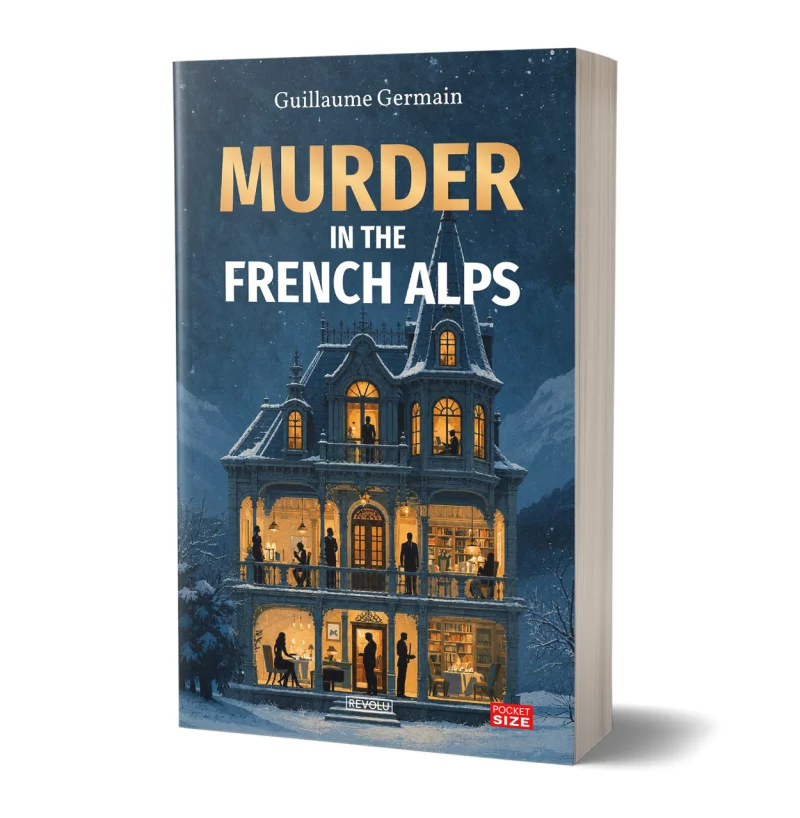
Murder in the French Alps
A closed-circle whodunit of poison, revenge and inheritance in a snowbound manor
Format broché
14,99 €
Format Kindle
7,99 €
Présentation
Deep winter in the French Alps. Snow closes the road to Henri Valvert's Belle Époque manor above Aix-les-Bains, sealing in five former partners who haven't been in the same room since the betrayal that destroyed their company twenty years ago.At five past midnight, Didier Lambert is dead. Poisoned. And the poison took five hours to work, which means it was already in him before dinner was served. Nobody saw it given.
Élise Martin, twenty-five, waits on the table. She is Valvert's adopted daughter, two years into a pharmacy degree she never finished, and she notices everything: what the silences cost, where the eyes travel, which guest has a reason. In this house every object has a second use. A silver saber. A bottle of Vintage 1970 port. A mirror that only looks like a mirror.
Every clue is on the page. The question is whether you'll see it before she does.
A closed-circle murder mystery in the classic tradition: no chases, no bodies in the street — six people, one long night, and a truth that turns out to be far easier to solve than it is to say out loud.
Extrait
The snow began to fall on Aix-les-Bains at four in the afternoon, which, according to the radio, was at least three hours ahead of schedule. Élise Martin learned this at the same moment she learned what still had to be bought for dinner, the list scrawled by Alain on a corner of tissue paper, as though he feared the ink of his own hand might soil the elegance of the evening. She folded the list carefully, slipped it into the pocket of her glazed cotton apron — a garment that suggested a fallen ballgown more than the uniform of a serving girl — and looked out the pantry window. The first flakes, fat and unhurried, wheeled through the lamplight like moths drunk on their own daring. “It’s snowing,” she said, to no one in particular. Perhaps to the pan of crème anglaise thickening on the stove, or to the decanter of port Alain had uncorked an hour earlier with a ritual slowness that suggested an act of remembrance rather than a household chore. Alain Fournier, the butler, did not look up. He was busy arranging five champagne flutes on a silver tray, each of a surgical cleanliness. The sixth — hers, because she always took the first sip to test the quality, as she put it, which nobody believed and everybody accepted — stood apart, half full, on top of the refrigerator. She had left on its rim, without meaning to, a print of garnet lipstick. “They’ll have trouble, poor devils,” Alain muttered at last. “The Revard road hasn’t been salted. And they’re forecasting a foot by midnight.” Élise could have answered that the five guests driving up from Paris were not the sort to fear snow, or trouble, but she said nothing. At twenty-five she had learned that silence was often the most intelligent reply to a remark that was not really a remark. She nodded and carried on into the drawing room, where the fire was crackling with a mechanical regularity. The Manoir des Cygnes, built in 1896 by a suicidal industrialist who had badly misjudged the consistency of his own foundations, was an excessive house in every sense of the word. Excessive in height, with a turret that threatened to puncture the cloud cover; excessive in breadth, with a gallery of Valvert portraits painted by three generations of mediocre men; excessive above all in ambition, as if the stone itself had set out to imitate the ostentation of its owners. Tonight, under porcelain lamps with fringed shades, it seemed at once overprotected and pointlessly sprawling — a fortress against an enemy who would not arrive through the snow, but through the front door. *** Henri Valvert, the master of the place, was waiting in the hall, straight as a wax figure, a glass of whisky in his hand. He was sixty-five, but his gaunt frame and his gray hair, cropped and immaculate, made him look nearer sixty, as though money had the power to reverse time by sheer force of will. He smiled when Élise appeared — a polite carnivore’s smile, which had less to do with the young woman than with the effect she produced on the general composition. “Late, of course,” he said, with a show of amusement. “Lambert always told me he respected no schedule but his own. A chief executive’s principle, apparently.” “Their flight was delayed, Monsieur,” Élise said, effacing herself against the doorframe. “They landed in Lyon at three. They should be here any minute.” Valvert nodded, satisfied. He valued in Élise the capacity to supply an answer before the question had been put, a quality he associated with good servants and good shareholders. He did not know — or preferred not to know — that she had abandoned a pharmacy degree two years earlier, and that her precision of mind was not domestic but scientific. It was one of the secrets they shared, though only by omission: he asked nothing about her past, and she volunteered nothing about his. The first car crunched up the drive at five forty-three. Alain opened the door with a protocol stiffness that would have done credit to a bailiff about to be decorated. The cold came in with the first arrivals, carrying a smell of the city, of stress, and of overpriced scent. Sophie Mercier crossed the threshold first, wrapped in a mink whose authenticity had been disputed by three generations of experts.