
English Books


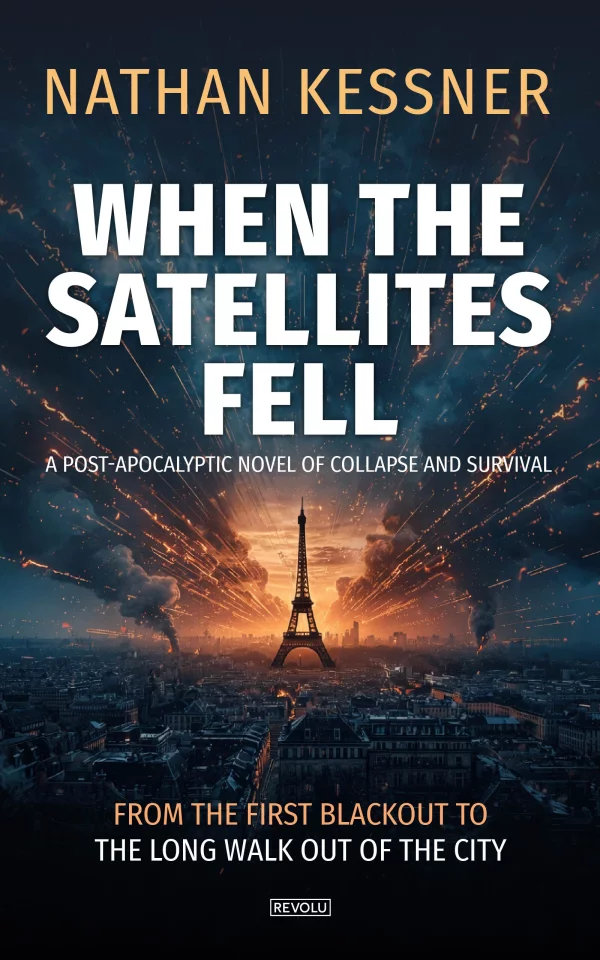
When the Satellites Fell
A post-apocalyptic novel of collapse and survival, from the first blackout to the long walk out of the city
Format broché
19,99 €
Format Kindle
9,99 €
Présentation
What happens to Paris when the sky stops working? On a January morning, a collision in low Earth orbit sets off a chain reaction that destroys thousands of satellites in a matter of hours. Across the city there is no GPS, no phone network, no power, no water pressure. Thomas Music is a network architect who has never once had to find his way without a screen. His wife Nora is a nurse who grew up under siege and knows exactly how fast a city empties. Their son records everything in a notebook. Their daughter has stopped speaking. When word comes that reactors in the northeast have begun to fail and the wind is turning toward the capital, they walk out of Paris on foot, four backpacks between them, heading for a stone house three hundred miles south that one of them barely remembers. The roads belong to other people now. Some of them are hungry. Some of them are organized. And the further the family walks, the clearer it becomes that arriving will cost more than the walking.Extrait
The coffee tasted like warm plastic. Thomas Music raised the cup to his lips a second time, out of habit rather than desire, and winced. The vending machine on Platform B of the RER A–the one at Nation station, the same machine for four years now, the same white cup with its brown stripe, the same overheated water poured over the same freeze-dried powder–had decided that morning to outdo its own mediocrity. The liquid was barely lukewarm, vaguely colored, with an aftertaste of pipework that brought back the drinking fountains of summer camp. Thomas swallowed anyway. At six fifty-two in the morning, on a Tuesday in January, you did not throw away a coffee, even a bad one. You drank it. You made a face. You got on the train. The platform smelled of iron and cold rain. January in Paris had a particular talent for turning the tunnels of the commuter rail network into damp cavities where the air sat still, thick with metal dust and a bodily humidity that belonged to no one in particular and to everyone at once. Thomas stood in his usual spot–fourth car, middle door, left-hand side–with the precision of a man whose habits formed the skeleton of his existence. Four years he had made this trip. Nation to La Défense. Forty-three minutes, if the gods of Paris transit were feeling generous. Fifty-eight if they weren’t. He took his phone out of his coat’s inside pocket. The screen lit up, obedient, and delivered its morning ration of notifications. Three work emails he wouldn’t read until he was sitting down. A weather alert–freezing rain in the afternoon, twenty-seven degrees after dark. The score of a rugby match he’d forgotten to follow the night before. And, wedged between a promotion from a shoe website and a reminder for a dental appointment, a wire story stamped 6:47 a.m.: SPACE–Major collision between two satellites in low Earth orbit. SpaceX confirms the loss of 12 Starlink units. The incident occurred at an altitude of 340 miles. Investigation underway. Thomas read it the way you read a score from a sport you don’t play–with that floating, courteous attention that engages only the surface of the brain. Twelve satellites. That was a lot, probably. Or not. He had no idea how many satellites were up there in total. Thousands, presumably. Twelve, measured against thousands, looked like a line item in a quarterly report–the kind of number somebody highlights in yellow, an executive frowns over in a meeting, and everyone forgets before lunch. The train came into the station with that hiss of compressed air and that complaint of hydraulic brakes Thomas had stopped hearing years ago. He got on, found a seat–a Tuesday miracle–and settled in. The car was three-quarters full. Faces that were familiar without being known: the man in the gray beanie who had been reading the same book since October, the woman in the navy suit who worked her phone with terrifying velocity, the two teenagers slumped against each other, earbuds screwed in, walled up in that generational silence Thomas observed in them without entirely understanding it. Everyone was looking at a screen. Thomas thought briefly, with the kind of morning clarity that would evaporate by his first meeting, that the car looked like a waiting room where no one knew what they were waiting for. Lowered heads, sliding thumbs, blue reflections on absent faces. Himself included. He slid his wireless earbuds in–a gesture as automatic by now as tying his shoes–and started an episode of a podcast on distributed network architecture. His job, essentially. Or at least the audio version, compressed and simplified, that he listened to on his commute the way a doctor watches a hospital drama: with a mixture of habit and affectionate condescension. The train pulled out. Thomas Music, forty-two years old, network architect and systems administrator at Cumulonimbus–a cloud services company housed in a La Défense tower whose pretentious name had never once made him smile–lived a life suspended entirely on invisible threads. Threads of data, of connections, of protocols. His phone woke him up. His wristband counted his steps and measured his sleep. The magnetic badge in his wallet opened the doors of the building, the elevator, the floor, the office. His laptop, permanently wired into six time zones, orchestrated the work of servers in Frankfurt, Dublin, and Singapore. The GPS in his phone guided him when he was looking for a restaurant. The banking app managed his accounts.