
English Books


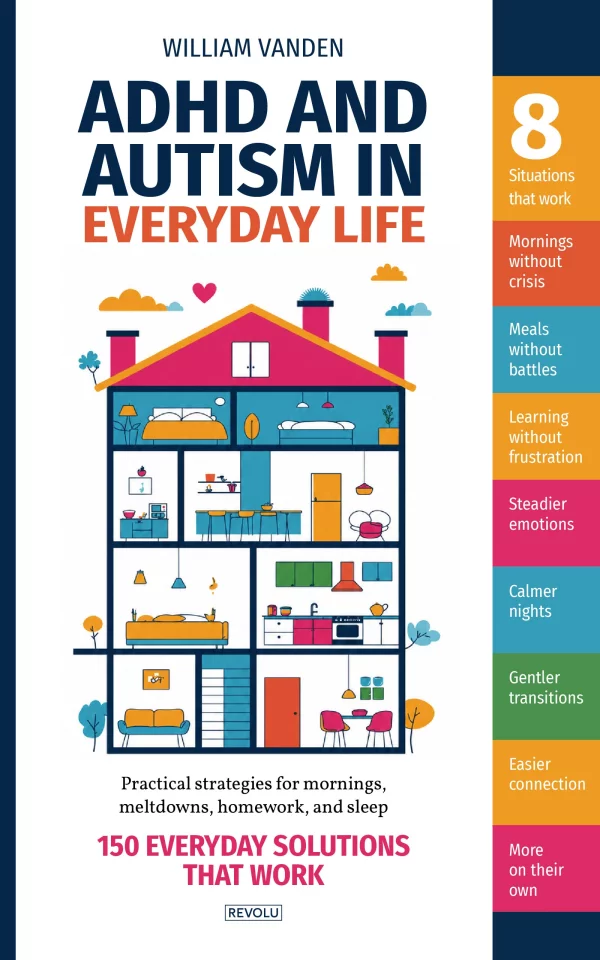
ADHD and Autism in Everyday Life
Practical strategies for mornings, meltdowns, homework, and sleep, written for parents, teachers, and neurodivergent adults.
Format broché
24,99 €
Format Kindle
8,99 €
Présentation
What if the moments that go wrong most often — mornings, meals, homework, bedtime — had more in common than the diagnoses behind them? This book is organized around situations rather than clinical categories, and it starts from an observation that runs through all of it: the same adjustment frequently helps an autistic child, an adult with ADHD, and someone with a learning difference, because what breaks down is rarely the label and almost always the fit between a nervous system and its surroundings. It moves across the routines that structure a day, the emotional and social terrain that rests on them, the physical spaces where difficulty concentrates, and the relationships that carry the whole thing. In each, it examines where the friction actually comes from and what shifts when the conditions shift. Parents, teachers, support professionals, and neurodivergent adults will each find material usable without specialized training and without waiting for a formal evaluation. The result is a way of reading everyday difficulty that makes it approachable, along with concrete adjustments that can be tried, adapted, and judged on what happens next.Sommaire
Introduction
Everyday Routines
Starting the Day Right
Meals Without Battles
Homework That Actually Works
Toward Calmer Nights
Emotions and Social Life
Riding Out Big Emotions
Navigating the Social World
Facing New Situations
Building on Strengths and Talents
Environments That Fit
A Home That Works
Succeeding at School
Free Time, Hobbies, and Activities
The Move Into Adulthood
Supporting and Communicating
Making Sense of Challenging Behavior
Communicating Clearly
Working with Professionals
Caring for the Caregiver
Extrait
Starting the Day Right Morning is an obstacle course for a great many neurodivergent people. The window between sleep and activity concentrates several demands at once: leaving a sleep state, completing a sequence of tasks in a fixed amount of time, absorbing the sensory noise of a household waking up—all of it under time pressure, and all of it before the nervous system has fully come online. For a lot of children and adults with neurodevelopmental differences, those first ninety minutes set the tone for everything that follows. A morning that goes badly is not just an unpleasant morning; it spends regulatory capacity that will be missing at eleven o’clock, and again at four. Waking Up Is a Neurological Transition Moving from sleep to alertness is not a switch. It is a full reorganization—thermoregulation, cortisol release, reactivation of the attentional networks—and it is measurably more demanding for some brains than others. Autistic people often need noticeably longer to come out of sleep, with certain circuits requiring an extended period to reactivate. People with ADHD frequently struggle to hold a stable level of arousal in the morning, producing either deep inertia or, at the other extreme, immediate agitation with no transitional phase in between. The difficulty compounds because sleep itself is often disrupted to begin with. Trouble falling asleep, night waking, and poor sleep quality accumulate into a chronic deficit that makes every subsequent waking harder. Melatonin secretion, which regulates the sleep-wake cycle, follows an atypical pattern in a significant proportion of autistic people, which is part of why an abrupt alarm can be so destabilizing.3 The practical implication is to make the transition gradual rather than sudden. A dawn-simulating lamp instead of a jarring alarm changes the experience substantially. So does building in a few extra minutes before leaving the bed, so the brain has time to arrive. For some people a short sequence of gentle movement or stretching helps synchronize body and mind before anything else is asked of them. Getting Started: The Problem of Morning Inertia Once awake, the next hurdle is initiating action. That process—which most people never think about—depends on executive functions that are frequently fragile in neurodivergent profiles. Executive dysfunction shows up as difficulty organizing, prioritizing, and starting actions, even completely routine ones. For people with ADHD, this often takes the form of starting inertia.4 The apparent contradiction—someone highly active in other contexts sitting frozen on the edge of the bed—is not laziness and is not a motivation problem in the ordinary sense. It reflects a different pattern of activation in the circuits that convert intention into movement. Autistic people more often report a different version: disorientation in the face of a stack of morning tasks, particularly when something has disrupted the usual order. A missing structure or an unannounced change can produce a cognitive overload that stops action entirely, and from the outside this looks like refusal. The most reliable countermeasure is an anchor action. Identify one first step so small it is nearly automatic, and let it trigger the sequence. Drinking a glass of water, stretching at the window, opening the blinds—the content matters less than two properties: it has to be easy enough not to constitute an obstacle in itself, and it has to be invariably the same. The anchor does not accomplish anything. Its job is to get the system moving. The Sensory Load of Morning Mornings concentrate a remarkable amount of sensory input into a short window. Sensory hypersensitivity—pronounced in autistic people but common across ADHD and specific learning differences as well—turns ordinary sensations into genuine assaults. Morning light can be too harsh, especially in winter when artificial lighting has to be switched on. The sounds of a house waking up—running water, dishes, voices still rough with sleep—can form an intolerable overlapping racket. Fabric textures register more intensely on skin that is still sensitized from sleep. Even breakfast smells, pleasant to one person, can overwhelm another. This intensity comes from atypical neurological processing of sensory information rather than from attitude. A brain that filters irrelevant stimuli less efficiently receives more of everything, and the resulting overload does not stay at the level of discomfort. It produces anxiety, irritability, and sometimes avoidance or self-regulatory behaviors that look inappropriate to an observer who is not experiencing the same input. Navigating this requires precision about the individual profile, because sensitivities vary enormously. One autistic person may tolerate loud sound while being extremely reactive to texture; another shows the reverse.