English Books


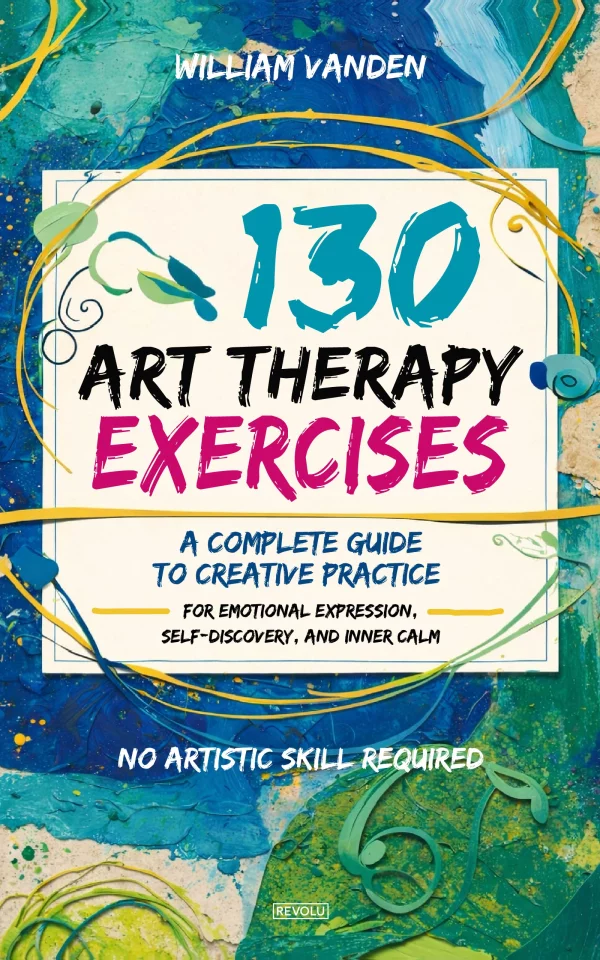
130 Art Therapy Exercises
A Complete Guide to Creative Practice for Emotional Expression, Self-Discovery, and Inner Calm, With No Artistic Skill Required
Format broché
19,90 €
Format Kindle
8,99 €
Présentation
What happens to a feeling that has nowhere to go? Some material never reaches words. It stays in the shoulders, in a mood that arrives without explanation, in a reaction that seems out of proportion to whatever set it off. This book offers a different route in, through drawing, painting, clay, collage and the plain act of making a mark. It gathers 130 self-directed exercises, each with its materials, its instructions and the time it takes, arranged in a sequence that begins with the body and moves through emotion, creative blocks, personal history and meditative practice. Alongside them sit the ideas the field rests on: what a color choice reveals, why handling raw material reaches early experience, how an image can hold what a sentence cannot. None of it asks for artistic skill, and several exercises are built so that a good result is not even available. What they ask for is a surface, half an hour, and the willingness to look at what comes out. The question left open is the one only practice answers: what will your own marks turn out to be saying?Sommaire
Art Therapy as a Path Back to Yourself
The Foundations of Therapeutic Art Practice
The Freeing Gesture
Body Imprints and Self-Awareness
From Color to Felt Sense
Texture and Creative Regression
Exploring Emotions Through Art
Mapping Inner Feelings
Dialogue With the Unconscious
Transforming the Inner Shadow
Moving Past Creative Blocks
Working Through Resistance
Silencing the Inner Critic
Art as a Tool for Change
Visual Metaphors for Change
Telling Your Story in Images
The Archaeology of Memory
Meditative Art Practice
Mindfulness Through Line
Daily Creative Rituals
Mandalas and Healing Circles
Active Contemplation
Extrait
The Freeing Gesture A spontaneous movement discharges tension the body has been holding. The mark it leaves on paper records the force behind it — the speed, the pressure, where the hand hesitated and where it committed. Those marks are legible in a way that the tension itself is not. The body keeps a record of what has happened to it. Experiences, injuries, and pleasures leave traces that shape how you stand, how you reach, how you flinch. Working through gesture gives you access to that record without having to describe it first, which is the point: description is exactly what tends to be unavailable. The Body’s Memory Chronic muscular tension is, among other things, a defense. Shoulders that stay raised were raised for a reason at some point, and stayed. Somatization — the appearance of physical symptoms where feeling has no verbal outlet — follows the same logic. The body carries what speech cannot. Repetitive gestures are worth noticing for a different reason. The way you hold a pen, cross your arms, or occupy a doorway is learned, and much of it is learned early, from the people around you. These patterns pass down through families the way accents do: absorbed rather than taught, and largely invisible to the person carrying them. That invisibility is what makes mark-making useful. A gesture performed onto paper becomes an object you can look at. What was habit becomes evidence. DID YOU KNOW Movement and emotion are not processed in separate compartments. The circuits that regulate affect and the circuits that plan and execute movement are densely interconnected, which is why physical states and emotional states influence each other in both directions — posture shifts mood, and mood shifts posture. This is also why the quality of a movement carries information. A large, fast, committed gesture and a small, hesitant one are not the same act performed at different scales. They correspond to different internal states, and the paper records the difference exactly. The practical consequence is that you do not need to identify a feeling before working with it. You need only to move and then look at what the movement produced. Catharsis Through Movement Large, spontaneous movement produces a discharge — a release of accumulated tension that is felt physically before it is understood. This is the oldest claim in expressive arts work and the most immediately verifiable one. Most people notice it within a single session. The mechanism is not mysterious. Broad movement changes breathing, changes heart rate, and interrupts the postural holding pattern that sustains a tense state. Doing this while leaving a visible trace adds something further: the release is externalized. It is on the wall, not in you. The exercises below are ordered by how much they ask of you. The first three are almost impossible to do wrong. The later ones require sustained attention and are more demanding physically. Gesture Release Exercises PRIMAL MARKS Large sheet of kraft paper, charcoal sticks, soft pastels Tape the sheet to a wall at chest height. Stand close enough to reach the whole surface without stepping. Close your eyes. Let your hand move across the paper without deciding in advance where it goes. Vary the pressure and the speed as the impulse comes. Do not open your eyes to check. When the time is up, step back and look at the whole sheet at once. 15 minutes BODY RHYTHMS Sheet of paper roughly 20 by 26 inches, oil pastels Sit or stand comfortably and breathe normally for a minute before touching the paper. Then draw in time with your breath: the mark grows on the inhale and settles on the exhale. Let the size of each mark follow the depth of the breath. Alternate deliberately between slow, extended breathing and faster, shallower breathing, and let the marks change accordingly. 20 minutes COLOR RELEASE Large sheet of heavy paper, liquid tempera or acrylic, wide brushes, drop cloth Lay the drop cloth down first — this exercise is not tidy. Load the brush and throw the paint onto the paper with your whole arm rather than your wrist. Use the entire surface, including the edges and corners. Change color whenever the impulse arrives, without deciding why. Keep the movements large enough that you feel them in your back and shoulders. 15 minutes DANCING HANDS Kraft paper, India ink, brushes of two or three widths Let both hands move on the paper as though they were dancing rather than drawing.