English Books

Technique is only part of the answer, and this book treats it that way. It brings together 130 complete scripts covering every phase of a session, from first contact to a clean return, with the vocal parameters, pacing, and observable signals that decide whether any of it lands.
Every script specifies what to say, how fast to say it, where to pause, and what to watch for while you are saying it. Common technical errors are named rather than implied. Adaptations are given for children, for skeptical clients, for the highly analytical, and for the ones who resist everything gentle.
Specialized chapters address anxiety, chronic pain, sleep, phobias, addiction, and trauma — each with the scope boundaries that tell you when the client in front of you belongs somewhere else. That judgment is treated as a clinical skill rather than a disclaimer.
The material is organized for use rather than for reading: findable during session preparation, and usable the same afternoon.
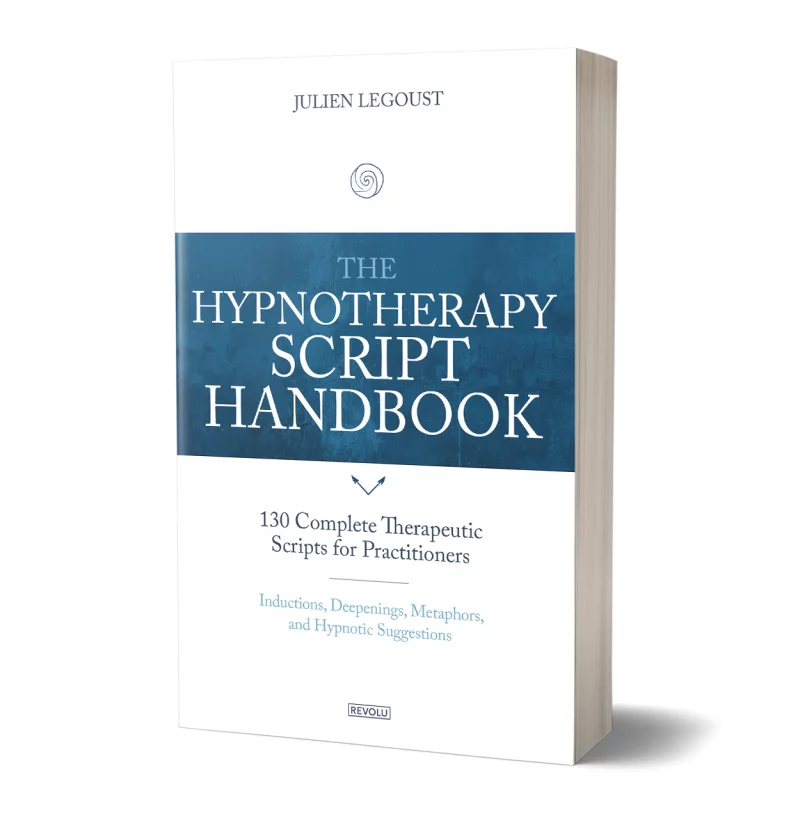
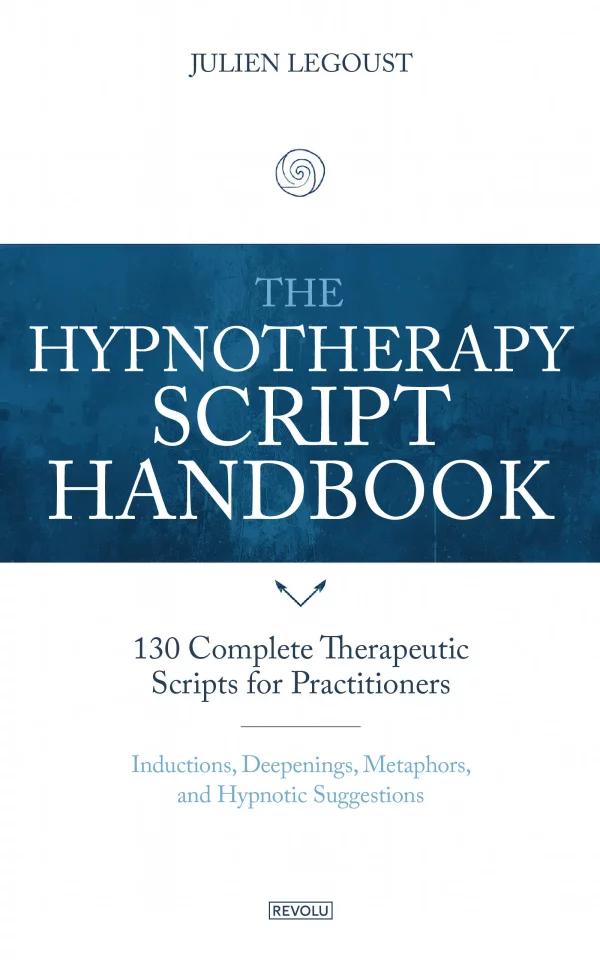
The Hypnotherapy Script Handbook
130 Complete Therapeutic Scripts for Practitioners: Inductions, Deepenings, Metaphors, and Hypnotic Suggestions
Format broché
26,90 €
Format Kindle
8,99 €
Présentation
What separates a hypnotherapy session that changes something from one that simply felt pleasant?Technique is only part of the answer, and this book treats it that way. It brings together 130 complete scripts covering every phase of a session, from first contact to a clean return, with the vocal parameters, pacing, and observable signals that decide whether any of it lands.
Every script specifies what to say, how fast to say it, where to pause, and what to watch for while you are saying it. Common technical errors are named rather than implied. Adaptations are given for children, for skeptical clients, for the highly analytical, and for the ones who resist everything gentle.
Specialized chapters address anxiety, chronic pain, sleep, phobias, addiction, and trauma — each with the scope boundaries that tell you when the client in front of you belongs somewhere else. That judgment is treated as a clinical skill rather than a disclaimer.
The material is organized for use rather than for reading: findable during session preparation, and usable the same afternoon.
Sommaire
Understanding the Foundations of Therapeutic Hypnosis
Using Scripts in Clinical Practice
Adapting Protocols to the Individual Client
Building Your Script Library
Classical Hypnotic Induction Scripts
Inducing Through Eye Fixation
Fixation on a point on the wall
Fixation on an object you hold
Fixation on the client’s own hand
Fixation with graded eyelid heaviness
Rapid fixation with countdown
Inducing Through Progressive Muscle Relaxation
Descending scan
Ascending scan
Bilateral scan
Tension and release
Continuous body scan
Inducing Through Descent
Classical staircase with countdown
Staircase in a house they know
Elevator with floor display
Ladder to an inner garden
Steps down to a beach
Inducing Through Hand Levitation
Direct progressive suggestion
Comparative lightness
Contrast between the two hands
Levitation inside a metaphor
Inducing Through Arm Catalepsy
Direct suggestion of building rigidity
Material transformation
Through dissociation
After levitation
With amnesia for the positioning
Contemporary Hypnotic Induction Scripts
Inducing Through Linguistic Confusion
Overload by multiple choice
Overload by syntax
Overload by broken logic
Overload by ambiguity
Inducing Through Pattern Interruption
The interrupted handshake
Interrupted counting
The unfinished sentence
Interrupted movement
Inducing Through Conversation
From personal history into absorption
Growing a spontaneous metaphor
Starting from something they enjoy
Reviving a resource memory
Inducing Through Sensory Overload
Multimodal overload
Overload by accumulated detail
Overload by rapid switching
Inducing Through Breath Focus
Watching the breath without changing it
Timing suggestions to the breath
Gradual slowing
Counted breathing
Abdominal breathing with visualization
Therapeutic Suggestion Scripts
Strengthening the Client’s Inner Resources
Reviving and amplifying a resource memory
Identifying transferable qualities
Seeing yourself competent
Building an internal resource place
Connecting with a figure who carries the quality
Extending forward in time
Anchoring what you’ve found
Integrating it into the client’s own story
Dissolving Resistance Through Reframing
Resistance as protection that can be redirected
The symptom as an attempt at a solution
Failure as necessary learning
Painful emotion as a legitimate signal
Installing Post-Hypnotic Anchors
Gestural anchor
Visual anchor
Auditory anchor
Kinesthetic anchor
Contextual anchor
Modifying Pain Perception
Dissociating the painful area
Changing the quality of the sensation
Moving it
Turning it down
Glove anesthesia
Working with meaning
Transforming Limiting Emotional Patterns
Working with excessive anxiety
Working with automatic anger
Working with pervasive sadness
Working with paralyzing shame
Rehearsing new behavior
Consolidating
Therapeutic Metaphor Scripts
Working with the Journey Metaphor
The train journey
The hike
The sea passage
The voyage outward
The initiatory journey
Building the journey together
Working with the Tree Metaphor
The tree through the seasons
The deep-rooted tree
The injured tree
The tree among trees
Working with the Ocean Metaphor
Descending through the layers
Rough surface, still depths
Meeting what lives there
The tide
Working with the Mountain Metaphor
The ascent
The mountain in weather
The view
Coming down
Working with the Metaphors of the Seasons
Spring: renewal after a hard period
Summer: fullness and extension
Autumn: what letting go is for
Winter: what happens in the dark
Running the full cycle
Scripts for Specific Clinical Problems
Treating Anxiety in Trance
Settling the body
Graded exposure to a trigger
Working on catastrophic anticipation
A place to go
Coming back to the present
Working with Trauma Through Dissociation
The observer position
Adding the second layer
The container
Working with Addiction
Strengthening motivation through projection
Uncoupling the associations
Finding what else could do the job
Riding out a craving
Planning for relapse
Managing Chronic Pain Through Modulation
Changing the quality
The intensity control
Moving it
Observing rather than being in it
Negotiating with it
Working on function rather than sensation
Addressing Sleep Problems
The transition script
Undoing the conditioning
Nighttime rumination
Getting back to sleep
Transforming Phobias Through Graded Exposure
The exposure protocol
The rehearsal of coping
Post-Hypnotic Reinforcement Scripts
Consolidating the Work Before You End
The basic consolidation
Amplifying a specific gain
Generalizing across contexts
Building the bridge to the week
Protecting against the first setback
Reorienting properly
Teaching Self-Hypnosis
The short induction
Building the trigger
Anchoring the Work in Daily Life
Naming the specific occasion
Attaching it to something existing
Environmental cues
Rehearsing the ordinary week
Reorientation Scripts
Bringing the Client Back
Functional reactivation
Counting the Client Up
The standard count of five
The count of ten
Extrait
Hypnosis has an image problem it did not earn. Decades of neurophysiological research support it. Major medical centers use it. And yet the word still calls up stage shows, swinging watches, and people clucking like chickens on command. That gap between the evidence and the reputation costs practitioners real ground—with clients, with referring physicians, sometimes with themselves. The reality is quieter. Hypnosis is a natural state of consciousness. You have entered it many times without naming it. Understanding how it works, and where its limits lie, lets you use it with the seriousness it deserves. What hypnosis actually is Hypnosis is an altered state of consciousness marked by focused attentional absorption and heightened responsiveness to suggestion. That definition is deliberately spare. It leaves out magnetic sleep, mind control, and every other inherited myth. You know the state already. You drive a familiar route and arrive without remembering the last few miles. A film pulls you in so completely that an hour disappears. A daydream takes hold and the room around you thins out. Same mechanism, no induction required. What shifts in that state is the relationship between conscious and automatic processing. Ordinarily your critical mind runs continuously—evaluating, filtering, holding a baseline vigilance. In hypnosis that filter loosens. It does not vanish. Therapeutic suggestions reach the systems governing perception, emotion, behavior, and some physiological functions more directly, because less is being intercepted on the way in. This is not sleep, and it is not unconsciousness. Your client stays awake. They can talk to you, refuse a suggestion that conflicts with their values, and come out of trance on their own if they need to. Say this plainly to anxious clients. It is true, and it is the foundation of a working alliance. What the brain is doing Functional imaging has moved hypnosis out of speculation and into measurable biology1. Three changes matter for practice. The anterior cingulate cortex, which handles focused attention and emotional regulation, shows increased activation. This corresponds to the absorption your client reports. The dorsolateral prefrontal cortex, which handles executive control and critical analysis, shows decreased activity. This is the loosened filter, visible on a scan. Connectivity shifts as well. Reduced coupling between the dorsolateral prefrontal cortex and the default mode network supports dissociation—the experience of watching your own reactions from outside. Increased coupling between that same prefrontal region and the anterior insula strengthens cortical influence over bodily processes, which is why hypnotic analgesia works at all. None of this is performance or compliance. These are reproducible functional reorganizations, distinct from what appears during rest, sleep, or ordinary relaxation. When a physician asks you what you are actually doing, this is the answer. Three traditions, one practice Therapeutic hypnosis carries three lineages. You will use all of them. Classical hypnosis developed through the nineteenth and early twentieth centuries. It is directive: authoritative, standardized suggestions delivered by a practitioner positioned as the expert. It seeks visible phenomena as evidence that the work is landing. It performs well with clients who respond to authority, and in medical settings where time is short. Ericksonian hypnosis emerged in the second half of the twentieth century through the work of Milton Erickson. Erickson worked from a different premise: the client already holds what they need, and the practitioner’s job is to open access to it rather than install something from outside. The tools follow from that premise—indirect suggestion, therapeutic metaphor, permissive language, continuous adjustment to what the client is actually doing rather than to what the protocol says should happen. Contemporary practice takes both inheritances and adds cognitive psychology, neuroscience, and brief therapy. The school allegiances have largely dissolved. What remains is a pragmatic question: what does this client, with this problem, in this setting, respond to? That is the right question. A competent practitioner uses directive suggestion for acute analgesia, elaborate metaphor for trauma work, and conversational suggestion for chronic anxiety—sometimes with the same client across a single course of treatment. The phenomena you will see Hypnotic states produce observable signs. These are not goals. They are readings—indicators of how engaged your client is, and how deep. Catalepsy is involuntary muscular rigidity held without apparent conscious effort. An arm stays suspended after suggestion, no tremor, no visible fatigue as the minutes pass. The client does not experience themselves as holding it. They notice that it is held. Hypnotic analgesia is reduced or abolished pain perception under suggestion.