
English Books

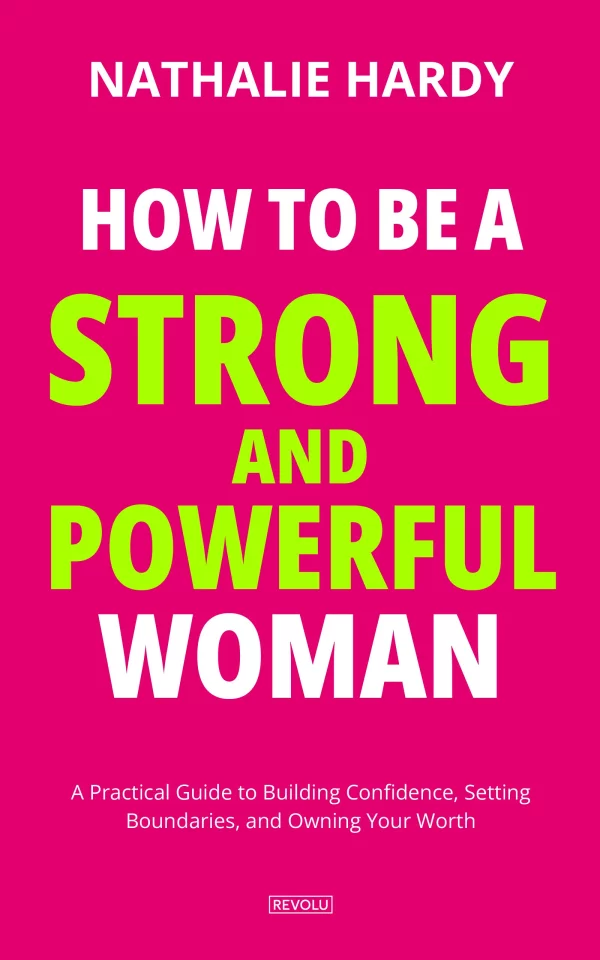
How to Be a Strong and Powerful Woman
A Practical Guide to Building Confidence, Setting Boundaries, and Owning Your Worth
Format broché
13,99 €
Format Kindle
6,99 €
Présentation
Why do so many women feel exhausted, invisible, or stuck — despite everything they accomplish? Why does saying no feel like a betrayal, asking for help like a failure, and taking up space like an act of aggression? This guide addresses these questions head-on, with no empty motivation and no abstract theory. It examines the psychological mechanisms that keep women locked in patterns of self-doubt, over-accommodation, and emotional overload — then provides structured, evidence-based tools to dismantle them. From identifying limiting beliefs and recognizing toxic behavioral patterns to setting firm boundaries, communicating with assertiveness, and reclaiming control over your own decisions, every section is built around concrete exercises, real-world situations, and techniques drawn from cognitive behavioral practice. This is a book designed to be used, not just read. It speaks directly to women navigating transitions, recovering from difficult relationships, rebuilding self-worth after setbacks, or simply recognizing that they have been living below their actual capacity. The approach is direct, the tone is honest, and the focus is relentlessly practical. If you have been waiting for permission to become the woman you already have the capacity to be, this is where you stop waiting.Sommaire
Why This Book
Introduction
WHAT HOLDS YOU BACK
Understanding What Real Strength Means
Identifying Your Limiting Beliefs
Recognizing Toxic Behavioral Patterns
Understanding Your Emotional Triggers
BUILDING UNSHAKABLE CONFIDENCE
Silencing Your Inner Critic
Reshaping Your Self-Image
Trusting Your Own Decisions
SETTING YOUR BOUNDARIES
Why You Fear Saying No
Protecting Your Emotional Space
Handling Manipulation With Clarity
RECLAIMING YOUR VOICE
Communicating With Assertiveness
Navigating Conflict Without Shrinking
Expressing Needs Without Apologizing
STEPPING INTO YOUR POWER
Cultivating Resilience Through Adversity
Leading Your Own Life
Embracing Your Unstoppable Strength
Extrait
Understanding What Real Strength Means Most women carry a definition of strength that does not belong to them. It was handed down — through family expectations, cultural narratives, social pressure — and absorbed so early that it feels like a personal conviction rather than an inherited script. Before you can build genuine strength, you need to examine the version you have been operating with, because there is a very high probability that it is working against you. This chapter is about pulling that definition apart, looking at where it came from, and replacing it with something that actually serves you. The Strength You Were Taught Think about the first woman you ever considered strong. Perhaps it was your mother, holding the household together while managing a full-time job, never complaining, never sitting down. Perhaps it was a teacher who seemed unshakable, or a public figure who appeared to have everything under control at all times. Whatever image comes to mind, notice what it emphasizes: endurance, self-sufficiency, emotional containment. The model of strength most women internalize is essentially a model of silent suffering dressed up as competence. This is not accidental. The messages girls receive from a very young age consistently reinforce the idea that strength means managing difficulty without making it visible. A boy who cries after losing a game may be told to toughen up, but a girl who cries is more often told that she needs to be a «big girl» — implying that emotional expression is a sign of immaturity rather than a normal human response. By the time she reaches adulthood, the average woman has absorbed thousands of these micro-instructions, and they have coalesced into a belief system that equates strength with the suppression of need. She has learned that strong women do not ask for help, do not show uncertainty, do not burden others with their struggles. She has learned, in short, that strength means disappearing her own humanity. The consequences of this inherited definition are visible in every clinical setting. Women who score high on measures of perceived competence — women whom others describe as «the strong one» in their family or social group — are disproportionately represented among those who report chronic exhaustion, emotional numbness, and a pervasive sense of isolation. The correlation is not coincidental. The role of the strong woman, as culturally defined, is inherently depleting because it requires constant performance with no space for recovery. You cannot sustain a public persona of unshakable solidity while simultaneously denying yourself permission to feel tired, confused, or overwhelmed. Something eventually gives, and when it does, the woman in question often interprets her own collapse as evidence that she was never truly strong to begin with — rather than recognizing it as the predictable result of an impossible standard. The Difference Between Armor and Strength There is a distinction that changes everything once you grasp it: the difference between strength and armor. Armor is what you build when you believe the world will hurt you if it sees who you really are. It is the composure you maintain during a meeting when your personal life is falling apart. It is the cheerful tone you use on the phone with your mother when you are actually furious. It is the «I’m fine» you deliver so convincingly that people have stopped asking whether it is true. Armor works — in the short term. It protects you from vulnerability, from judgment, from the risk of being seen as less than capable. But it exacts a price that compounds over time. Women who rely heavily on emotional armor often describe a particular kind of loneliness: they are surrounded by people who admire them, rely on them, even love them — and yet feel fundamentally unseen. This makes perfect sense. If the version of yourself that others interact with is a carefully managed performance, then the affection and respect you receive are directed at the performance, not at you. The real you — the one who doubts, who struggles, who sometimes does not know what to do — remains hidden, and therefore remains alone. This is the paradox of armor: the better it works, the more isolated you become. Genuine strength operates on entirely different principles. Where armor conceals, strength integrates. A woman who has developed authentic strength does not need to hide her uncertainty, because she understands that uncertainty is not a deficiency — it is information. She does not need to suppress her emotions, because she has learned to use them as data rather than treating them as threats. She does not need to manage everyone’s perception of her, because her sense of self is anchored internally rather than dependent on external validation. This kind of strength does not look like invincibility. It looks like a woman who is fully present in her own life, including the difficult parts, and who responds to challenges with clarity rather than reactivity. The transition from armor to strength is not a single dramatic moment. It is a gradual process of learning to tolerate being seen — imperfections included — and discovering that the consequences are rarely as catastrophic as the armor led you to believe. In clinical practice, this is often the turning point: the moment a woman allows herself to be genuinely vulnerable with another person and realizes that the relationship did not end, the respect did not evaporate, the world did not collapse. That single experience of surviving vulnerability without disaster is more powerful than a hundred affirmations about self-worth. Reality Check The idea that a strong woman never shows weakness is one of the most persistent and damaging myths in contemporary culture. Clinical observation reveals a consistent finding: women who maintain a facade of permanent solidity are significantly more likely to experience anxiety disorders, somatic symptoms such as chronic headaches and digestive issues, and episodes of emotional overwhelm that feel disproportionate to the triggering event. The «never show weakness» rule does not produce strong women — it produces exhausted women who have lost access to their own emotional signals. Acknowledging difficulty is not a failure of strength. It is a prerequisite for it. Every woman who has genuinely transformed her relationship with herself did so by first admitting — to herself, then to at least one other person — that the version of strength she had been performing was costing her more than she could afford. What Authentic Strength Actually Requires If strength is not armor, then what is it made of? The answer, grounded in decades of clinical research and therapeutic practice, involves three components that rarely appear in popular self-help discourse: the capacity for accurate self-perception, the willingness to act despite discomfort, and the ability to hold complexity without collapsing into simplification. The first component — accurate self-perception — means seeing yourself as you actually are, not as you fear you are, and not as you wish you were. Most women oscillate between self-deprecation and compensatory idealization. In one moment, they are convinced they are inadequate; in the next, they are performing a version of themselves designed to prove otherwise. Neither position reflects reality. Accurate self-perception requires tolerating a more nuanced picture: you are competent in some areas and not in others, you have genuine gifts and genuine limitations, and neither of these facts defines your worth as a person. This sounds simple. In practice, it is one of the hardest psychological achievements there is, because it requires abandoning both the comfort of self-criticism (which at least feels familiar) and the comfort of overperformance (which at least earns approval). The second component — willingness to act despite discomfort — is what separates strength from mere insight. Many women understand their patterns intellectually. They can articulate exactly why they avoid conflict, why they over-function in relationships, why they struggle to assert their needs. Understanding is necessary but radically insufficient. Strength becomes real only at the moment you do the thing that frightens you — say no when you want to say yes, speak up when your instinct is to stay silent, walk away from a situation that diminishes you even though leaving feels terrifying. The discomfort does not disappear. You learn to act in its presence rather than waiting for it to subside, because if you wait, you will wait forever. The third component — holding complexity — is perhaps the least discussed and the most essential. The culturally dominant model of strength is binary: you are either strong or weak, in control or falling apart, winning or losing. Real life operates on entirely different terms. A woman can be simultaneously grieving a loss and excelling at work. She can love someone deeply and recognize that the relationship is harmful. She can feel proud of how far she has come and frustrated by how far she still has to go.